
Ancient Secrets Revealed with Flir Thermal Imaging
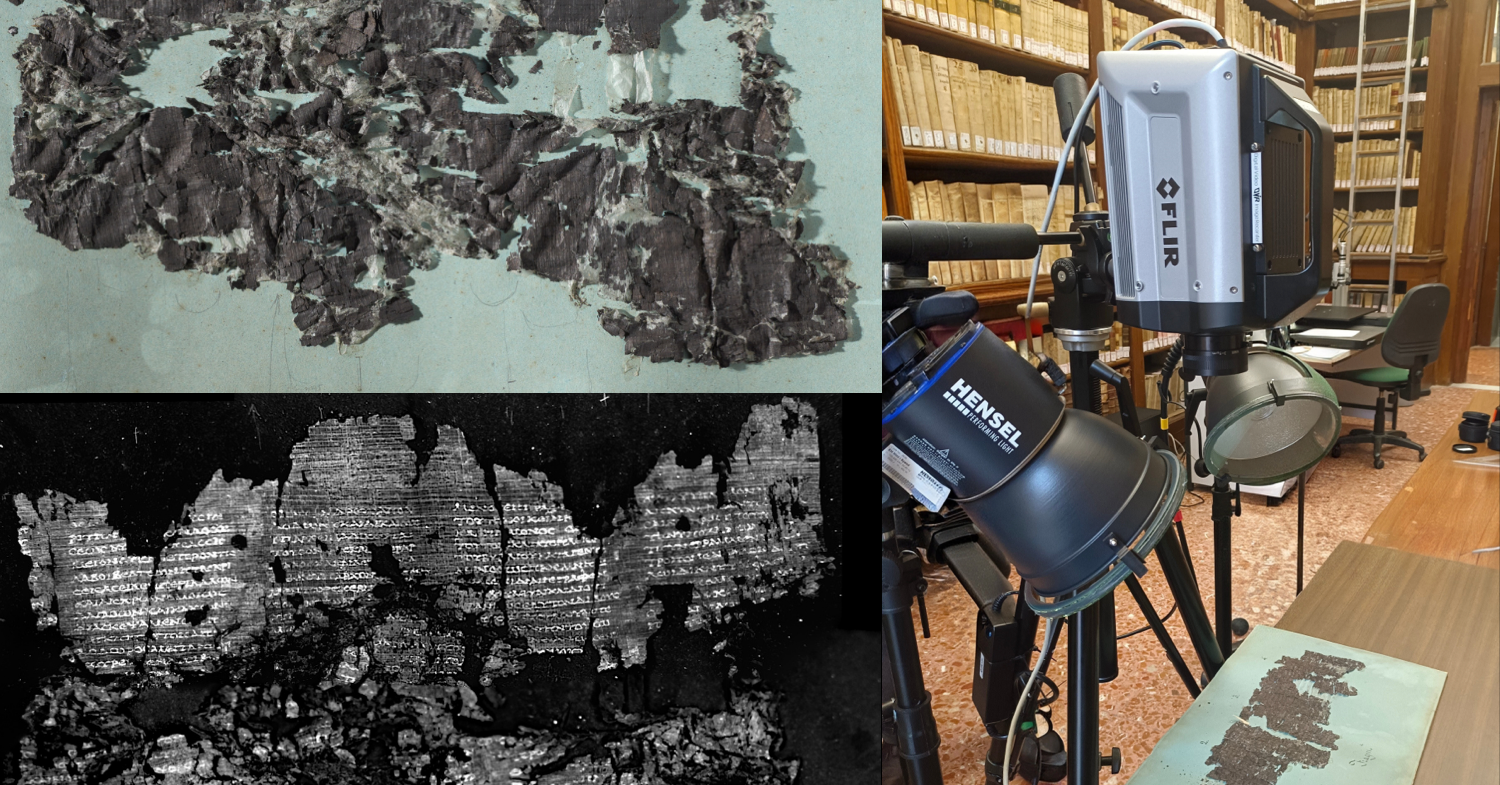
What if thermal imaging could help researchers read texts that have been hidden for almost 2,000 years? Well, that’s exactly what scientists in Italy are doing with the famous Herculaneum papyri: ancient scrolls carbonized during the eruption of Mount Vesuvius in 79 AD.
These fragile manuscripts are incredibly important because they represent the only surviving library from the ancient Greco-Roman world. The problem is that many of the texts are now almost impossible to read. The papyri are heavily damaged, layered, and extremely delicate, which means researchers cannot physically separate the multilayers without risking permanent damage.
So how do you reveal hidden writing without touching the artefact? The answer is pulsed thermography supported by high-speed, high-sensitivity Flir X-Series thermal imaging cameras and their 2.775 MHz fast analog lock-in input port.
The process works by briefly illuminating the papyrus with controlled light and recording its thermal response over time. As the ink and papyrus substrate absorb heat differently, hidden writing becomes visible in the thermal data.
What makes this technique especially interesting is that different information appears at different times during the thermal sequence:
In other words, researchers are not just recovering text, they are also learning more about the physical condition and structure of the manuscripts themselves.
The work is being carried out by researchers at CNR ISPC (Institute of Heritage Science of the National Research Council of Italy), including Giovanni Caruso and Loredana Luvidi, who specialise in applying advanced non-destructive imaging techniques to cultural heritage research. Their work focuses on uncovering information hidden within historical artefacts while preserving the integrity of the original material. For the Herculaneum papyri project, their expertise helped combine pulsed thermography with thermal data analysis to reveal previously unreadable text and provide new insight into the structure and condition of these extraordinary manuscripts.
At the centre of the project are Flir X-Series cooled thermal imaging cameras, combining high-speed infrared imaging with the high sensitivity needed to detect extremely subtle thermal contrasts in fragile materials. Capturing data at such high speed is critical because some of the most important thermal information appears almost instantly after light excitation.
Another major advantage is that the entire process remains completely non-contact and non-destructive, which is essential when working with priceless historical artefacts.
The research team is now exploring AI-assisted processing techniques to improve text recovery even further.
Ultimately, projects like this show how Flir thermal imaging technology is helping researchers preserve and better understand some of the world’s most important cultural treasures.
For more information about our X-Series thermal imaging camera, click here.

High-Speed MWIR Science-Grade Camera

High-Speed LWIR Science-Grade Camera

High Definition MWIR Science-Grade Camera

High-Speed LWIR Science-Grade Camera
