
How Flir’s Si1-LD Camera Enables Measurable GHG Emissions Reduction

Yamabiko Corporation is a comprehensive manufacturer that operates globally in the manufacturing and sales of small outdoor power equipment and various other types of machinery. Recognizing its responsibility to help preserve the global environment, the company has set a medium-term goal to halve greenhouse gas (GHG) emissions associated with its business operations by 2030 and is implementing a company-wide carbon-neutral strategy that encompasses its manufacturing processes.
At the heart of this effort is the reduction of emissions through the optimization of energy use. In particular, the company focused on compressed air systems—a major contributor to electricity consumption in factories—and identified measures to address air leaks as a priority issue.
Flir recently spoke with Mr. Yokoyama and Ms. Yamane of the Equipment and Environment Section, Production Engineering Department, Production Engineering Division, Production Headquarters, about the visualization of air leaks using the acoustic camera "Si1-LD" and the benefits of this technology.

From the left: Ms. Yamane and Mr. Yokoyama
Guided by its corporate philosophy of "creat(ing) the bridge that bonds people and nature with the future," Yamabiko Corporation recognizes the efforts addressing climate change as a key management priorities. To achieve carbon neutrality, the company has been successfully working toward its medium-term goal to halve GHG emissions associated with its business activities by 2030. Established in early 2025, the Equipment and Environment Section, which Mr. Yokoyama and Ms. Yamane belong, is responsible for implementing facility management and environmental measures.
The first specific measure that came to mind was improving the efficiency of the compressor equipment. “Since the compressors accounted for a great deal of the factory's electricity consumption, we first considered measures focused on the compressors and their surrounding areas,” explains
Mr. Yokoyama. “While I was aware that our compressors were used extensively in our daily operations and could sense the sound of air leaks, I couldn't determine whether the machines were broken or needed repair, and how much it would cost, which made it difficult to take action.”
The solution to this problem is the Flir acoustic imaging camera, Si1-LD.
“I was attracted to this acoustic imaging camera, which is capable of detecting and quantifying pressure leaks, because it allowed us to visualize the leak rate and convert it into monetary loss figures. We are now able to address issues that were previously difficult to quantify based on solid evidence,” says Ms. Yamane. As a result, decisions regarding repairs—which previously relied on subjective judgment—have shifted to decision-making based on quantitative data.

Clear visualization of air leaks via noise-canceling feature
In fact, the company previously considered introducing acoustic imaging cameras on the production floor, going as far as to conduct internal testing. Once the Equipment and Environment Section received a request to implement such a system, the team determined that a comprehensive approach would yield the best results and began exploring the matter.
“In manufacturing operations, ‘on-site suitability’ is a key evaluation criterion,” Ms. Yamane explains. “The area where the casting machines are operating is extremely noisy. We were testing a product on the production floor and received feedback from the floor that the background noise made it difficult to identify air leaks clearly. However, the Si1-LD features a noise-canceling function, and the fact that it can clearly pinpoint air leaks even in such environments was the deciding factor in our decision to adopt it.”
Mr. Yokoyama adds, “It is also nice that you can operate it with just one hand. Since it is actually used on-site, I feel that ease of use and clarity in that setting are important.”

Mr. Yokoyama and Ms. Yamane browsing a cloud-based image-sharing library
A key feature of the company's efforts is that it goes beyond mere detection to include company-wide implementation through the use of data. “GHG emissions and the reduction achieved through countermeasures must be calculated and reported, both in aggregate and by facility. Flir's cloud-based software, Acoustic Viewer, allows you to export data such as leak rate and monetary loss figures, along with images, to Excel,” says Mr. Yokoyama.
Furthermore, sharing information on the cloud makes it possible to:
“If a major leak is discovered, we also see benefits in rolling out the relevant countermeasures to other plants through the Acoustic Viewer. We are currently using a configuration that manages systems by organization to operate a single camera across multiple locations, thereby working toward company-wide optimization,” Ms. Yamane says.
Going forward, the company plans to expand the use of this system at the Yokosuka, Morioka, and Hiroshima plants and report the emission reductions achieved through the Si1-LD as specific figures. Nowadays, measures to prevent air leaks using the Si1-LD are not merely equipment improvements but have become a key means of implementing carbon-neutral strategies at the operational level. “Even in cases where it was difficult to determine the right time for repairs, visualization and cost estimates make it easier to get started. We hope this will lead to company-wide progress with these measures,” says Ms. Yamane. By quantifying "hidden losses" and sharing them throughout the organization, this initiative can be considered a practical model for GHG reductions in the manufacturing sector.
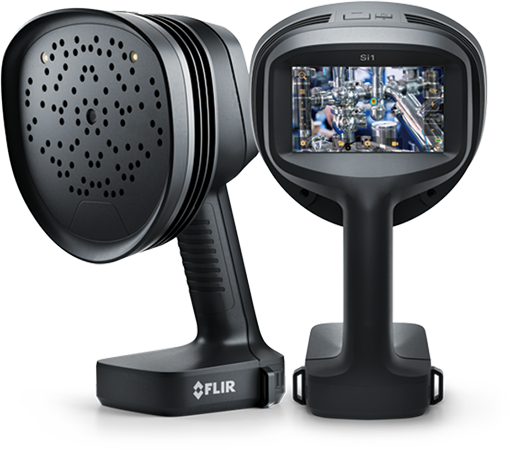
Flir Si1-LD Industrial Acoustic Camera
It detects and visualizes ultrasonic waves generated by leaks in pipes and other systems. With 124 built-in microphones, it accurately detects even the slightest air leaks.
Click here for details> https://www.flir.com/products/si1-ld/
As part of its educational support initiatives, Flir Systems Japan provides on-site implementation support and training for the use of cameras in maintenance operations. The industry as a whole is working to further improve safety and convenience.
For Product Demonstrations and Support Inquiries
info@Flir.jp
*The affiliations and job titles of individuals appearing in this article are those at the time of the interview.