Clean Air Act Update: What EPA’s Methane Policy Changes Mean for OGI and LDAR Programs
Recent EPA actions have caused confusion across the oil and gas sector, with some headlines suggesting methane monitoring is no longer required. In reality, while certain methane-related provisions were delayed or repealed, existing requirements for monitoring and reporting volatile organic compounds (VOCs) and hazardous air pollutants (HAP) remain in place. Misinterpreting these changes can expose operators to compliance and operational risk regarding their Leak Detection and Repair (LDAR) programs.
Revocation of Earlier EPA Decision
The EPA’s February 12, 2026 rescission of the 2009 Endangerment Finding represents one of the most significant shifts in U.S. air‑emissions policy in decades. The original finding concluded that greenhouse gases—including methane—endanger public health and welfare, which provided the legal basis for regulating these gases under the Clean Air Act. Removing this determination undermines that foundation.
While the most immediate effects are centered around mobile sources and fall on sectors such as transportation, the oil and gas industry must now evaluate how this change could influence future regulation of methane and related emissions. The full implications are still developing, but the decision introduces new uncertainty for long‑term compliance planning.
“It’s important to note,” said Craig O’Neill, Global Director of Business Development, Flir, “that the February 2026 rescission applies specifically to mobile sources regulated under Clean Air Act, that is, primarily automobiles.” It does not directly alter stationary‑source requirements (such as those in OOOOa, OOOOb, or OOOOc), but it does create future legal and regulatory uncertainty around how EPA may revise or defend methane rules for the oil and gas sector.
What Actually Changed
Between 2024 and 2026, several methane‑related regulatory actions were modified:
Methane Emissions Fee (WEC) repealed
OOOOb/OOOOc compliance deadlines extended
Methane reporting requirements delayed to October 30, 2026
Methane fee implementation delayed until 2034
Additional time granted for leak repair and equipment replacement
These changes reduced short‑term regulatory pressure, but they did not eliminate methane oversight.
“Because VOC and HAP regulations were not part of the recent rollbacks, most leaks remain regulated regardless of methane‑specific changes,” said O’Neill. “In many cases, enforcement focus has shifted rather than disappeared, particularly toward non‑methane pollutants.”
Understanding Pollutants and Greenhouse Gases
To understand how the EPA regulates the oil and gas industry, it helps to distinguish between pollutants and greenhouse gases.
Pollutants, such as nitrous oxides (NOx), HAPs (Hazardous Air Pollutants), and volatile organic compounds (VOCs) are carefully regulated because the release of these chemicals into the atmosphere produces smog and creates a health hazard.
Greenhouse gases, such as carbon dioxide and methane, have been regulated because they contribute to global warming per the 2009 Endangerment Finding. Although methane is chemically a VOC, it is not regulated as a VOC, because it has negligible photochemical reactivity. This distinction explains why methane and VOC regulations follow different legal pathways.
EPA Regulations and Technology Recommendations
First, let’s take a brief look at how EPA’s methane and LDAR framework developed in order to understand where OGI fits today. In 2007, the U.S. Supreme Court ruled in Massachusetts v. EPA that greenhouse gases such as CO₂ and methane qualify as air pollutants under the Clean Air Act. This opened the door for federal regulation of greenhouse gas emissions.
Two years later, in 2009, the EPA issued the Endangerment Finding, determining that six greenhouse gases, including methane, pose a risk to public health and welfare. This decision reshaped regulatory expectations across multiple industries, especially transportation.
Within the oil and gas sector, leak detection has long been part of routine operations, with inspections performed at wellheads, separators, tanks, and other equipment. Historically, the primary EPA‑recommended method for Leak Detection and Repair (LDAR) was “Method 21,” which uses an instrumented probe to measure gas concentrations in parts per million.
In 2008, Optical Gas Imaging (OGI) was approved as an alternative LDAR technology. As the EPA continued evaluating field performance, OGI gained prominence for its ability to visually locate leaks quickly, pinpoint the source, and streamline inspection workflows. By 2015, the EPA formally identified OGI as the recommended LDAR method, with Method 21 serving as the alternative technology.
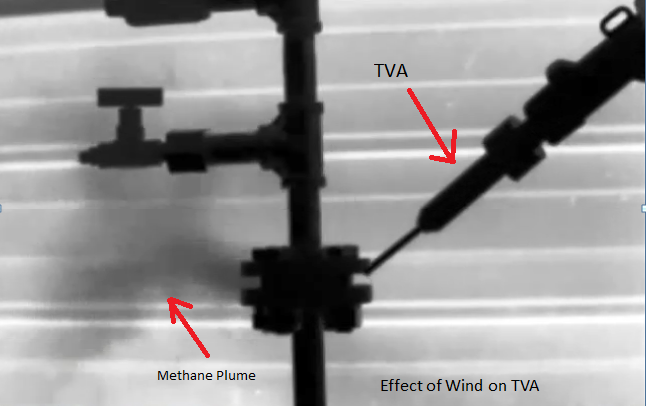
IR image from an OGI camera showing an emission and effects of wind to detect with various technologies.
“EPA’s regulatory framework has evolved significantly over the past two decades, and each shift has pushed the industry toward more effective tools for detecting and reducing emissions,” explained O’Neill. “As OGI technology matured, it proved indispensable, because operators can see leaks in real time, identify their exact source, and take action immediately. That visual clarity and efficiency are why OGI has become central to modern LDAR programs and why it remains so critical to compliance today.”
The Impact of the Current EPA Change
The repeal of the Endangerment Finding signals a major shift in how EPA views its authority to regulate greenhouse gas emissions. Without this foundational determination, federal GHG regulation becomes less certain, and EPA has begun reconsidering rules that relied on the original finding across multiple sectors—not just transportation.
This policy shift also aligns with broader trends already underway: delays to methane requirements finalized in 2025, including postponed deadlines for leak detection, monitoring, venting, and flaring reductions. As a result, there is heightened uncertainty around how EPA may handle future standards for stationary‑source methane regulations such as NSPS OOOOa, OOOOb, and OOOOc.
Importantly, these actions do not eliminate air‑quality oversight. State programs, permitting obligations, and all non‑GHG Clean Air Act provisions—including VOC and HAP regulations—remain fully enforceable. For most oil and gas operations, these pollutant‑based requirements drive the bulk of LDAR activity.
Even if future EPA actions extend the repeal to stationary sources, most oil and gas facilities will still need to comply with VOC‑centric rules. Because VOCs are often the dominant emissions component at many sites, day‑to‑day LDAR practices—and the role of technologies like OGI—remain largely unchanged under today’s regulatory framework.
Preparing for the Future
The future remains uncertain for stationary‑source methane regulation, and this creates ongoing strategic risk for oil and gas operators, particularly for LDAR programs that have grown more sophisticated over the past decade.
In the near term or if the Endangerment Finding is applied to stationary sources, the rollback may reduce certain federal compliance burdens and reporting obligations. However, three realities temper the perception of deregulation:
Legal uncertainty: The rescission is widely expected to face court challenges, potentially leading to years of regulatory flux.
State, global and investor pressure: Many states, capital markets, and international frameworks—such as the EU Methane Rule—continue to require strong methane management regardless of federal shifts.
Operational and reputational risk: Methane emissions remain a key metric for environmental performance and community relations, particularly as natural gas producers position themselves as a lower-carbon fuel.
Why OGI Monitoring Still Matters
Regulatory uncertainty increases the need for defensible, comprehensive emissions data. Optical gas imaging supports compliance across federal and state programs, protects against future rule changes, and reduces risk tied to incomplete monitoring strategies.
Why Methane‑Only Monitoring Falls Short
Many LDAR solutions on the market are designed solely for methane detection. In a regulatory environment where methane rules are evolving, but VOC and HAP oversight remains firm, methane‑only tools leave compliance gaps. OGI provides defensible data. Operators must be able to detect:
Methane
Volatile organic compounds (VOCs)
Hazardous air pollutants (HAPs)
(Note: Methane and VOCs often co‑exist in the same emission stream and throughout the separation process methane composition is diluted, making it more challenging for methane-only technologies to visualize emissions.)
No matter the outcome of any future regulatory changes tied to the Endangerment Finding, Optical Gas Imaging technology will be central to the oil and gas industry’s efforts to mitigate emissions. OGI remains authorized as LDAR’ BSER under NSPS rules.
“While there may be some uncertainty related to regulatory actions and how it applies to LDAR for stationary sources, OGI Cameras will be central to empowering oil and gas companies to reduce emissions related to leak detection both now and in the future,” O’Neill adds.
Capability
Methane‑Only Tools
OGI
Methane detection
✔
✔
VOC detection
✘
✔
LDAR support
Limited
Comprehensive
State‑level compliance
Partial
Strong
Future regulatory resilience
Low
High
Conclusion
Even as the regulatory landscape shifts, the market-driven expectations for emissions transparency and control are unlikely to disappear. Optical gas imaging cameras are not just a necessity for regulatory compliance, they have become the best operational practice because they foster efficient leak detection, strengthen operational performance, improve safety and establish better reporting opportunities for customers and investors.
Maintaining robust LDAR programs provides resilience against future federal changes and helps operators stay aligned with state, market, and global standards. In today’s industry, consistent leak detection is not only a compliance requirement, it is a sound business strategy.
Want to know more about how OGI supports your regulatory requirements? Fill out the form below to get in touch.
This material is provided for informational purposes only and does not constitute legal advice. Regulatory requirements vary by jurisdiction. Always consult qualified legal counsel for guidance specific to your organization.